


What Happens If Pancreatic Disease Is Left Untreated?

The pancreas helps digest food and controls blood sugar, so when it becomes inflamed or damaged, the effects can impact the whole body.
Most pancreatic disease does not announce itself.
A vague upper-abdominal ache. Bloating after meals. Stools that float and smell different. A small cyst spotted incidentally on a scan ordered for something else. By the time pancreatic disease declares itself especially cancers, the conversation has usually become much harder than it had to be.
The honest, evidence-based answer to "what happens if I leave this alone?" depends entirely on what "this" actually is. For some pancreatic conditions, watchful waiting is the correct, guideline-supported decision. For others, every week of delay shortens the patient's life. The skill is in knowing which is which.
Here is what the evidence actually shows.
What Is Pancreatic Disease?
The pancreas produces digestive enzymes and hormones such as insulin and glucagon. When the pancreas becomes inflamed or damaged, often due to gallstones, alcohol use, high triglycerides, or other causes, it can lead to pancreatitis (acute or chronic), exocrine pancreatic insufficiency (EPI), or the need for advanced treatment such as pancreatic surgery Singapore in severe cases. If left untreated, repeated damage can change the structure and function of the pancreas, allowing serious complications to develop over time.
Symptoms of Pancreatic Disease You Should Not Ignore

In the early stages, symptoms can seem vague or flu‑like, which is why many people delay seeing a doctor. Common early signs include:
Constant or recurrent upper‑abdominal pain that may radiate to the back
Nausea and vomiting, especially after meals
Loss of appetite and unintentional weight loss
Bloating and discomfort after eating
If treatment is delayed, these symptoms can become more persistent and severe. Over time, chronic inflammation can cause the pancreas to scar and shrink, reducing its ability to produce enzymes and insulin. Early review by a pancreas doctor Singapore can help identify the cause and guide treatment.
What Happens If Pancreatic Disease Is Left Untreated?
It depends on the condition

Some nontreated pancreatic disease can worsen over time, leading to serious health problems. Ongoing inflammation may damage the pancreas permanently and affect digestion, blood sugar control, and overall health.
Acute pancreatitis: most people recover. A minority do not.
Acute pancreatitis is one of the most common gastrointestinal reasons for hospital admission worldwide, with an incidence of around 34 cases per 100,000 people. About 80% of episodes are mild and self-limiting, with a mortality below 1%. It is the other 20% — moderately severe and severe acute pancreatitis — that defines the disease.
20–30% mortality in severe acute pancreatitis with infected pancreatic necrosis.
In severe acute pancreatitis, parts of the pancreas die. About 20% of severe cases develop pancreatic necrosis; roughly 30% of those will go on to become infected. Once infection is established, mortality rises sharply, into the 20–30% range in modern series. These patients spend weeks to months in ICU, often need percutaneous or endoscopic drainage, sometimes surgical debridement, and a substantial proportion are left with permanent endocrine and exocrine insufficiency.
Gallstone pancreatitis: the recurrence is preventable, and the trial proves it.
If your acute pancreatitis was caused by gallstones, leaving the gallbladder behind is not optional. Delaying the surgery means roughly one in six patients is back in hospital — sometimes with a second, worse pancreatitis — before they would have had their operation.
This is one of the cleanest examples in surgery of why timing matters.
Chronic pancreatitis: a slow disease with a fast cancer signal
Chronic pancreatitis is fibrosis of the pancreas, usually from years of alcohol, smoking, genetic susceptibility, or repeated acute attacks. The gland scars. The ducts strictures. Calcium deposits accumulate. Insulin- and enzyme-producing cells are destroyed. The result is the well-recognised triad of relentless pain, malabsorption (steatorrhoea, weight loss), and so-called "Type 3c" diabetes.
Beyond quality of life, chronic pancreatitis carries a substantial pancreatic cancer signal that most patients are never told about.
22.6x increased pancreatic cancer risk in chronic pancreatitis vs general population.
Untreated chronic pancreatitis is not just a slow decline. It is a slow decline punctuated by a real, definable cancer risk.
Pancreatic cysts: where "watch and wait" is often correct
This is the area where the public conversation has become most distorted. Pancreatic cysts are common — incidentally detected on 1–3% of CT scans and on up to 40% of MRI scans in older patients. Most are completely benign and can be safely watched.
The 2024 International Evidence-Based Kyoto Guidelines stratify management of intraductal papillary mucinous neoplasms (IPMNs) — the commonest neoplastic cysts — by risk:
High-risk stigmata (main pancreatic duct ≥10mm, enhancing mural nodule ≥5mm, obstructive jaundice from the cyst) → surgical resection is recommended in fit patients.
Worrisome features (cyst ≥3cm, mural nodule <5mm, thickened cyst wall, main duct 5–9mm, new-onset diabetes, elevated CA 19-9, rapid growth) → endoscopic ultrasound evaluation, multidisciplinary discussion, surgery if additional risk.
Small branch-duct IPMN with no concerning features → surveillance with imaging at intervals of 6 months to 2 years depending on size.
Main-duct IPMN, mucinous cystic neoplasms >3 cm in young patients, and any cyst harbouring high-grade dysplasia behaves differently — these need to come out, and the longer they sit, the higher the risk of invasive malignancy on final pathology.
The distinction matters because both errors are common: cysts that should be watched are sometimes resected unnecessarily, and cysts that should be resected are sometimes watched too long.
Pancreatic adenocarcinoma: the disease that does not give you time
This is the part of the conversation where delay has the highest cost.
3–6 months median survival for untreated advanced pancreatic ductal adenocarcinoma.
Median survival for untreated advanced pancreatic ductal adenocarcinoma is approximately 3 to 6 months. With modern systemic chemotherapy (FOLFIRINOX or gemcitabine/nab-paclitaxel), median survival in metastatic disease extends to 8–12 months. With curative-intent surgical resection plus adjuvant chemotherapy for respectable disease, median survival reaches 25 to 35 months, and a meaningful proportion of patients become long-term survivors.
The hard truth is that only a minority of patients are diagnosed early enough for curative resection. About two-thirds present with locally advanced or metastatic disease, where surgery is no longer the first move. This is why incidentally-found findings — a 1cm dilated pancreatic duct, an unexplained new diabetes after age 50, a vague upper-abdominal ache that doesn't go away, a 5kg weight loss with no other explanation — deserve a proper workup, not reassurance.
Modern pancreatic cancer pathway is multidisciplinary, sequenced, and time-sensitive.
Role of Imaging in Diagnosis and Monitoring
Imaging is key to diagnosing pancreatic disease and spotting complications before they become emergencies. Common tests include:
Ultrasound
Ultrasound is often the first imaging test used. It helps check for gallstones, bile duct blockages, swelling, and changes in the pancreas.
CT Scan
A CT scan provides detailed images of the pancreas. It helps detect inflammation, fluid collections, pseudocysts, tissue damage, and other serious complications. CT scans also help plan pancreatic surgery Singapore when surgery is needed.
MRI / MRCP
MRI and MRCP create clear images of the pancreas, bile ducts, and surrounding tissues. These scans are useful for spotting narrowing, blockages, cysts, and early chronic pancreatitis.
Endoscopic Ultrasound (EUS) and ERCP
EUS gives highly detailed close-up images of the pancreas and ducts. ERCP can diagnose and treat certain blockages. These tests may also help a pancreatic cancer specialist Singapore evaluate suspicious growths or collect biopsy samples.
If treatment is delayed, imaging may reveal pseudocysts, narrowed ducts, and early warning signs of cancer. Repeat scans also help doctors track disease progression and decide if treatment needs to change.
When Should You See a Doctor Immediately?
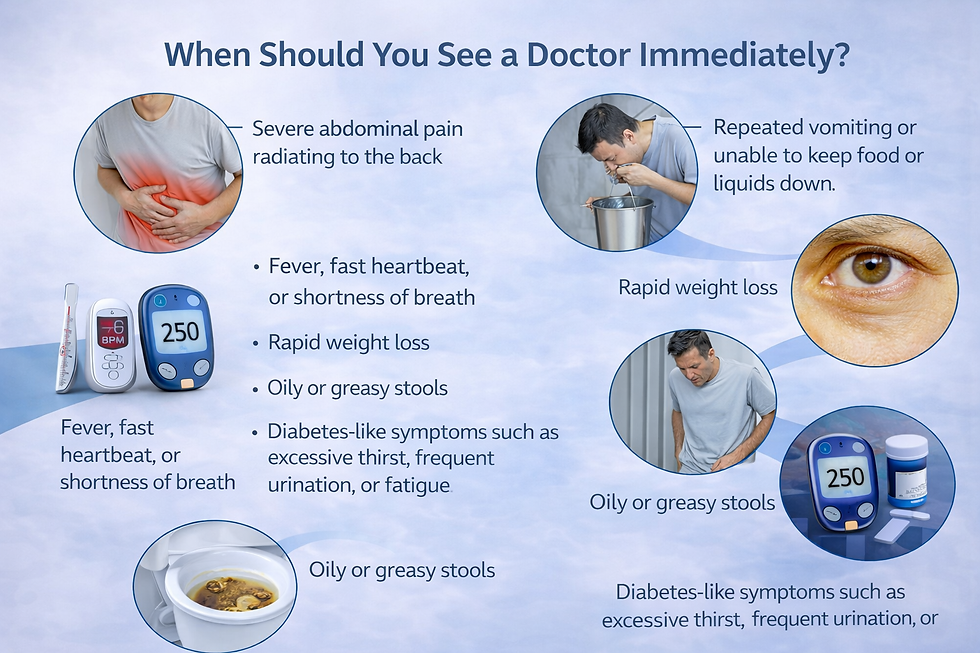
Early symptoms of pancreatic disease can seem mild, but some warning signs need urgent medical attention. Seek help quickly if you notice:
Severe abdominal pain that spreads to the back
Repeated vomiting or inability to keep food or liquids down
Fever, fast heartbeat, or shortness of breath
Rapid weight loss
Oily or greasy stools
Diabetes-like symptoms such as excessive thirst, frequent urination, or fatigue
Yellowing of the skin or eyes
If pancreatic disease is left untreated, these symptoms may mean the condition has progressed. Early treatment through medication, enzyme replacement, lifestyle changes, and pancreatic surgery Singapore can reduce pain, prevent complications, and improve quality of life.
Conclusion: A Note from Alps Clinic
Pancreatic disease should never be ignored. What starts as mild stomach discomfort, bloating, or occasional pain can turn into serious complications if left untreated. Ongoing inflammation may lead to poor digestion, weight loss, diabetes, infection, or long-term damage to the pancreas.
The good news is that early diagnosis can make a major difference. If you notice persistent abdominal pain, digestive problems, or unexplained weight loss, seek medical advice early. Consulting a trusted pancreas doctor Singapore can help protect your health and improve outcomes.



Comments